Types and risk groups
Acute Promyelocytic Leukaemia (APL) is a rare type of acute myeloid leukaemia (AML). AML is a type of blood cancer that affects the blood and bone marrow. It starts from the fast, uncontrolled growth of early white blood cells. These are called myeloid stem cells.
APL develops from a type of myeloid cell called a promyelocyte. It is also called APML or AML M3.
To understand how and why leukaemia affects you as it does, it helps to know how you make blood cells.
Your body makes in the bone marrow. The bone marrow is the soft, spongy tissue in the inner part of your bones. You make blood cells in a controlled way, as your body needs them. This continuous supply keeps your blood healthy and your body functioning properly.
All blood cells start as the same type of cell, called a stem cell. This stem cell can turn into any type of blood cell. The stem cell can develop into:
myeloid stem cells
lymphoid stem cells
Myeloid stem cells become:
monocytes
red blood cells
platelets
white blood cells called granulocytes - neutrophils are a type of granulocyte
Lymphoid stem cells develop into white blood cells called lymphocytes. Examples include B lymphocytes and T lymphocytes.
The diagram below helps to explain this:

In acute myeloid leukaemia, the bone marrow makes too many monocytes or granulocytes. These cells are not fully developed and are not able to work normally.
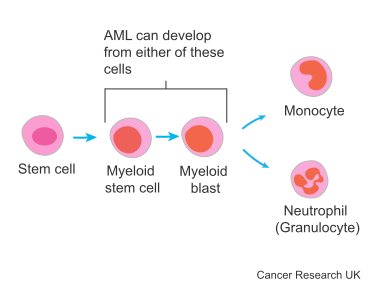
APL develops from myeloid cells called promyelocytes. Promyelocytes normally develop into granulocytes. In APL, there are too many promyelocytes. They don’t develop properly and there is not enough room for normal healthy blood cells to develop and work.
APL is very rare. In the UK, around 170 people are diagnosed with APL every year.
In APL, the levels of red blood cells, white blood cells, and platelets are low. This is called pancytopenia. This can cause:
infections
tiredness
bruising and bleeding
You may also have some weight loss.
Your GP will usually arrange for you to have a blood test if you have these symptoms. They may then refer you to a specialist if your blood test results are abnormal. Or if your GP suspects you have leukaemia.
APL can cause serious bleeding and clotting complications. Your doctor will diagnose and treat you urgently if they suspect APL.
A specialist in blood disorders is called a haematologist. Your specialist will take a sample (biopsy) of your bone marrow. They look at the cells under a microscope to check for leukaemia cells.
You will also have other tests on bone marrow and blood samples to look for any in the leukaemia cells. These genetic tests can confirm a diagnosis of APL.
Most people with APL have a gene change called PML-RARA fusion.
PML and RARA are the names of . Fusion means part of the PML gene breaks off from 15 and attaches to the RARA gene on chromosome 17. The medical name for this is translocation. These stick together (fuse) which causes the PML-RARA fusion.
This fusion is a mistake that causes cancer cells to develop. This gene change happens in your lifetime. It is not something you have inherited from your parents or pass on to your children.
PML-RARA fusion is the most common gene change in APL. Some people have a different gene change. Doctors use the name 'variant APL' if you have one of these rarer gene changes.
Knowing about these gene changes can help your specialist plan your treatment.
Find out more about the different types of tests you might have
APL can develop very quickly so you will start treatment straight away. This is usually before all of your test results are back. Treatment aims to get rid of all signs of APL. This is known as remission.
A specialist hospital looks after you. The healthcare team is used to treating people with APL. You stay in hospital for your first treatment. Your team carefully monitors you when you start treatment and until you are safe to go home.
The main treatment for APL is tretinoin. This is also called ATRA or all-trans-retinoic-acid. Tretinoin belongs to a group of drugs called retinoids. They are similar to vitamin A. You take tretinoin as tablets. You might start taking this if your doctor suspects that you have APL. This often starts before all your test results are back.
If you start treatment and tests show you do not have APL, you will stop taking tretinoin.
If you have APL, you usually have a combination of these chemotherapy drugs:
tretinoin (ATRA)
arsenic trioxide
Some people also have other chemotherapy drugs such as idarubicin and mitoxantrone. But this is less common.
You have some of these drugs into a vein (intravenously) and some as tablets. Your healthcare team can explain this to you in more detail.
Go to more information about each of these drugs on our A to Z list of cancer drugs
Your treatment might be different if you have a rare type of APL called variant APL. This means your APL does not have the PML-RARA gene change.
Your treatment will also depend on your general health and fitness.
APL treatment is divided into 3 main phases. These are called induction, consolidation and maintenance. Not everyone has all 3 phases. This depends on your situation.
The aim of the induction phase is to destroy as many leukaemia cells as possible.
This phase aims to get rid of any leukaemia cells that might still be there. And to lower the risk of the leukaemia coming back.
Your hospital team might recommend maintenance treatment. This depends on your risk of the APL coming back (relapsing). Maintenance treatment aims to help keep the leukaemia away. This is called remission.
You do not have maintenance treatment if your relapse risk is low. You are more likely to have maintenance treatment if your risk of relapse is higher.
APL can cause your blood cells to drop to very low levels. You usually need treatment to help correct this and relieve symptoms. Some supportive treatments replacing low levels of substances in your blood. You have them through a drip and they might include:
if the level of your is low
if your count is low
fresh frozen plasma (FFP) to help stop you from bleeding. This is the fluid part of blood and contains essential proteins and clotting factors
cryoprecipitate to help stop you from bleeding. This is made from FFP and is a more concentrated
Other supportive treatments include:
antibiotics to help prevent or treat infections
anti sickness medicine to help prevent or relieve sickness
The side effects of APL treatment vary from person to person. Not everyone gets these side effects. But your team closely monitor you when you have this treatment.
We have detailed information about treatment side effects on each cancer drug page.
Go to our Cancer drugs A to Z list
A common side effect of taking ATRA or arsenic trioxide is differentiation syndrome. You might also hear it called retinoic acid or ATRA syndrome. It can happen anytime from when you start treatment with ATRA to up to several weeks into treatment. It can be mild or potentially be life threatening. Symptoms can include:
high temperature (fever) of unknown cause
weight gain
fluid build up in your hands, arms, legs and feet (peripheral oedema)
shortness of breath
chest pain
dry cough
low blood pressure that can cause you to feel lightheaded or dizzy
not passing enough wee
feeling confused
tiredness and weakness
feeling sick
You might have a steroid called dexamethasone to try and prevent differentiation syndrome. This depends on your white blood cell count at diagnosis.
If you develop differentiation syndrome while on treatment you start treatment with dexamethasone. You may also need other treatment to help you such as:
oxygen if you are breathless
medicine to help get rid of any extra fluid you may have
transfusions of blood, platelets and substances that help your blood to clot
Your doctor might give you hydroxyurea if your white blood count gets very high. You can usually continue your APL treatment if your symptoms improve with steroids and hydroxyurea.
If you do not get better, or you become very unwell, you might have to pause your treatment. This is until your symptoms improve. You will then be able to start your treatment again once it is safe to do so.
APL that comes back is called relapsed APL. If it doesn’t go away with treatment, it is called refractory APL.
For relapsed or refractory APL you usually have more treatment. This depends on treatment you have already had. For example, you might try a chemotherapy you have not had before.
Some people may have a , but this is less common. A transplant allows you to have high doses of chemotherapy and other treatments such as .
Find out more about a stem cell transplant and its side effects
Researchers continually look for ways to improve treatment. There may be fewer clinical trials for rare sub types of leukaemia such as APL. But you can ask your healthcare team if there is anything suitable for you.
Researchers in the UK are carrying out trials for people with AML. This includes people with APL.
Go to our trials database to look for AML trials
Coping with a leukaemia diagnosis can be difficult, both practically and emotionally. Having information about APL and treatment can help you make decisions and cope.
Read more about coping with AML
You might want to know more about your outlook (). Treatment for APL often works well, especially if you are diagnosed and treated early. Treatment outcomes have improved with drugs such as tretinoin (ATRA) and arsenic trioxide. Your own prognosis will depend on many factors. Your doctors will tell you more about this.
Talking to other people who have the same thing can also help. As APL is rare, you may not meet other people with exactly the same type of AML to you. In this situation, national organisations and their forums might be useful.
Our discussion forum Cancer Chat is a place for anyone affected by cancer. You can share experiences, stories and information with other people who know what you are going through.
Blood Cancer UK have information about APL, as well as a support phone service and a community forum.
Last reviewed: 06 Nov 2026
Next review due: 06 Nov 2029
Chemotherapy is the main treatment for acute myeloid leukaemia (AML). Other treatments include a stem cell transplant and targeted cancer drugs.
Chemotherapy is the main treatment for acute myeloid leukaemia (AML). Chemotherapy uses anti cancer (cytotoxic) drugs to destroy cancer cells. The drugs circulate throughout the body in the bloodstream.
Doctors divide AML into different groups (subtypes). They also divide AML into risk groups based on genetic changes and other factors.
Support is available to help you cope during and after acute myeloid leukaemia (AML) treatment. This includes information on diet, physical activity, sex, fertility and life after a transplant.
AML is a type of blood cancer that starts in white blood cells in the bone marrow. Find out about the symptoms, risks, treatment and support for people with AML.